American Sign Language Alphabet Chart Printable
The ASL manual alphabet uses one hand to spell names, places and words that don’t have their own signs. This chart describes each of the 26 handshapes step by step with a simplified finger-position diagram, and the practice tool spells any word letter by letter at the speed you choose. Learning directly from Deaf signers or videos is the best way to see the exact shapes.
ASL Alphabet Printable Pack
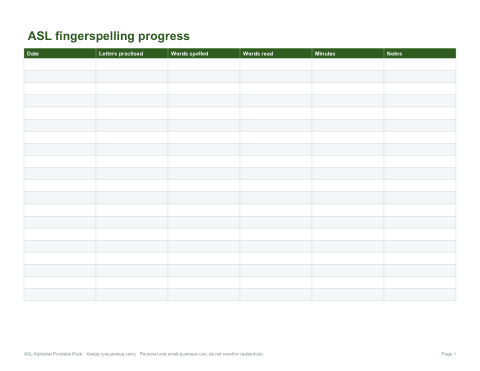
Printable ASL alphabet chart with written handshape descriptions, a blank chart for your own photos, letter flash cards, fingerspelling word lists and a progress tracker.
- Alphabet chart (PDF/DOCX)
- Blank photo chart (PDF)
- Flash cards (PDF)
- Word lists (PDF/DOCX)
- Progress tracker (PDF/DOCX/XLSX)
Formats: PDF, DOCX, XLSX. Instant download after payment (link valid 72 hours, up to 5 downloads). AI-assisted: the templates were drafted with AI help and reviewed and laid out by Kedop.
$5.00 USD, one-time
Secure card checkout by Stripe. Full refund within 7 days — see the refund policy and license.
Use the american sign language alphabet chart printable
What’s in the pack
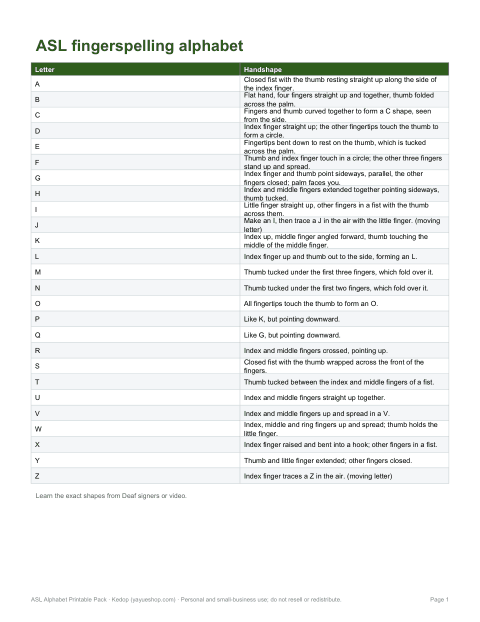
- Printable ASL alphabet chart with a written description for every handshape
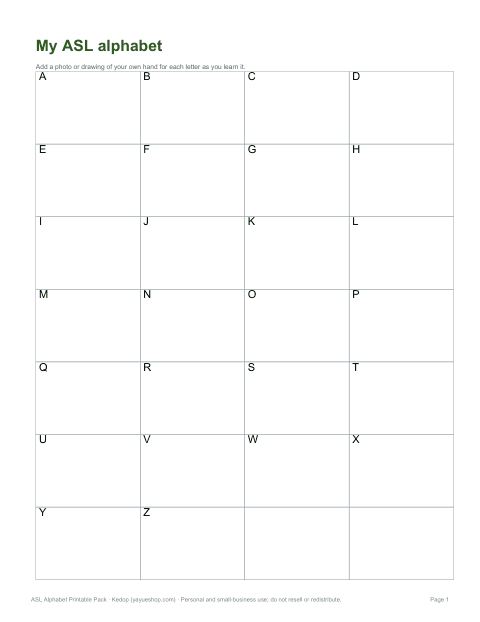
- Blank chart to add your own photos or drawings as you learn
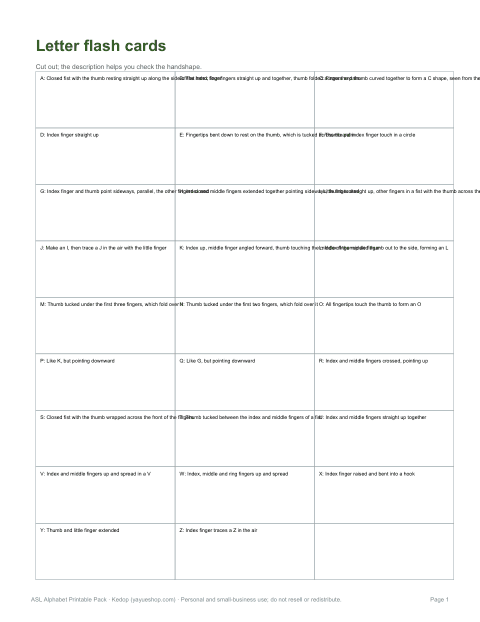
- Letter flash cards with descriptions on the back
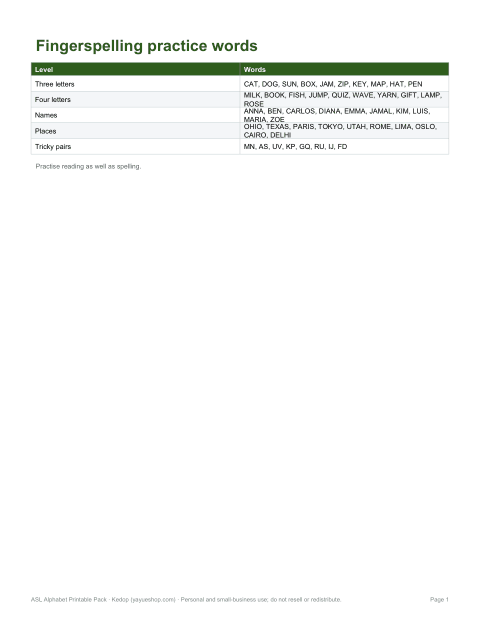
- Fingerspelling practice word lists (names, places, three- and four-letter words)
- Progress tracker
The diagrams on this page and in the pack are simplified finger-position guides; they don’t show every detail of hand orientation, so pair them with video from Deaf signers.
The 26 handshapes
| Letter | How to form it |
|---|---|
| A | Closed fist with the thumb resting straight up along the side of the index finger. |
| B | Flat hand, four fingers straight up and together, thumb folded across the palm. |
| C | Fingers and thumb curved together to form a C shape, seen from the side. |
| D | Index finger straight up; the other fingertips touch the thumb to form a circle. |
| E | Fingertips bent down to rest on the thumb, which is tucked across the palm. |
| F | Thumb and index finger touch in a circle; the other three fingers stand up and spread. |
| G | Index finger and thumb point sideways, parallel, the other fingers closed; palm faces you. |
| H | Index and middle fingers extended together pointing sideways, thumb tucked. |
| I | Little finger straight up, other fingers in a fist with the thumb across them. |
| J | Make an I, then trace a J in the air with the little finger. |
| K | Index up, middle finger angled forward, thumb touching the middle of the middle finger. |
| L | Index finger up and thumb out to the side, forming an L. |
| M | Thumb tucked under the first three fingers, which fold over it. |
| N | Thumb tucked under the first two fingers, which fold over it. |
| O | All fingertips touch the thumb to form an O. |
| P | Like K, but pointing downward. |
| Q | Like G, but pointing downward. |
| R | Index and middle fingers crossed, pointing up. |
| S | Closed fist with the thumb wrapped across the front of the fingers. |
| T | Thumb tucked between the index and middle fingers of a fist. |
| U | Index and middle fingers straight up together. |
| V | Index and middle fingers up and spread in a V. |
| W | Index, middle and ring fingers up and spread; thumb holds the little finger. |
| X | Index finger raised and bent into a hook; other fingers in a fist. |
| Y | Thumb and little finger extended; other fingers closed. |
| Z | Index finger traces a Z in the air. |
Hold your dominant hand at about shoulder height, palm generally facing the person you’re signing to (except where noted), and keep your hand relaxed and steady.
Letters that are easy to confuse
| Letters | Difference |
|---|---|
| A, S, T | Where the thumb goes: along the side (A), across the front (S), tucked between index and middle (T) |
| M, N | Thumb under three fingers (M) or two fingers (N) |
| U, V, R | Fingers together (U), apart (V) or crossed (R) |
| K, P | Same shape; P points down |
| G, Q | Same shape; Q points down |
| I, J | J adds a movement, tracing a J |
| D, F, O | Which fingers join the thumb |
Worked example: spelling a name
To introduce yourself as Emma, sign “my name” and then fingerspell E-M-M-A. For the double M, many signers make the M and then slide it slightly to the side rather than bouncing it twice. In the practice tool, type EMMA and press Play at a slow speed to rehearse the sequence: E (fingertips over the thumb), M (thumb under three fingers), M again, then A (fist with the thumb along the side).
Tips for clear fingerspelling
- Keep your hand in one place — don’t bounce on each letter.
- Aim for a smooth rhythm rather than speed.
- Read fingerspelling by word shape, not letter by letter, as fluency grows.
- Mouth the word silently if that helps you keep pace.
- Practise reading as much as producing — it’s usually the harder skill.
Learning ASL respectfully
ASL is a complete language with its own grammar, used by Deaf communities in the United States and parts of Canada. Fingerspelling is only a small part of it — most words have their own signs. The best way to learn is from Deaf teachers, community classes and Deaf-created video resources, which show handshapes, movement and facial grammar that no printed chart can capture.
AI-assisted content
These descriptions and templates were drafted with AI assistance and reviewed by Kedop. Simplified diagrams are learning aids, not a substitute for instruction from fluent signers.
Frequently asked questions
How many letters are in the ASL alphabet?
26 — one handshape for each letter of the English alphabet.
Which ASL letters move?
J and Z, which trace their shapes in the air.
Is fingerspelling the same in all sign languages?
No — British Sign Language, for example, uses a two-handed alphabet.
Should I use my right or left hand?
Use your dominant hand.
How can I get better at reading fingerspelling?
Practise with videos and native signers, focusing on word shapes.
Is this a subscription?
No, the pack is a one-time download.